
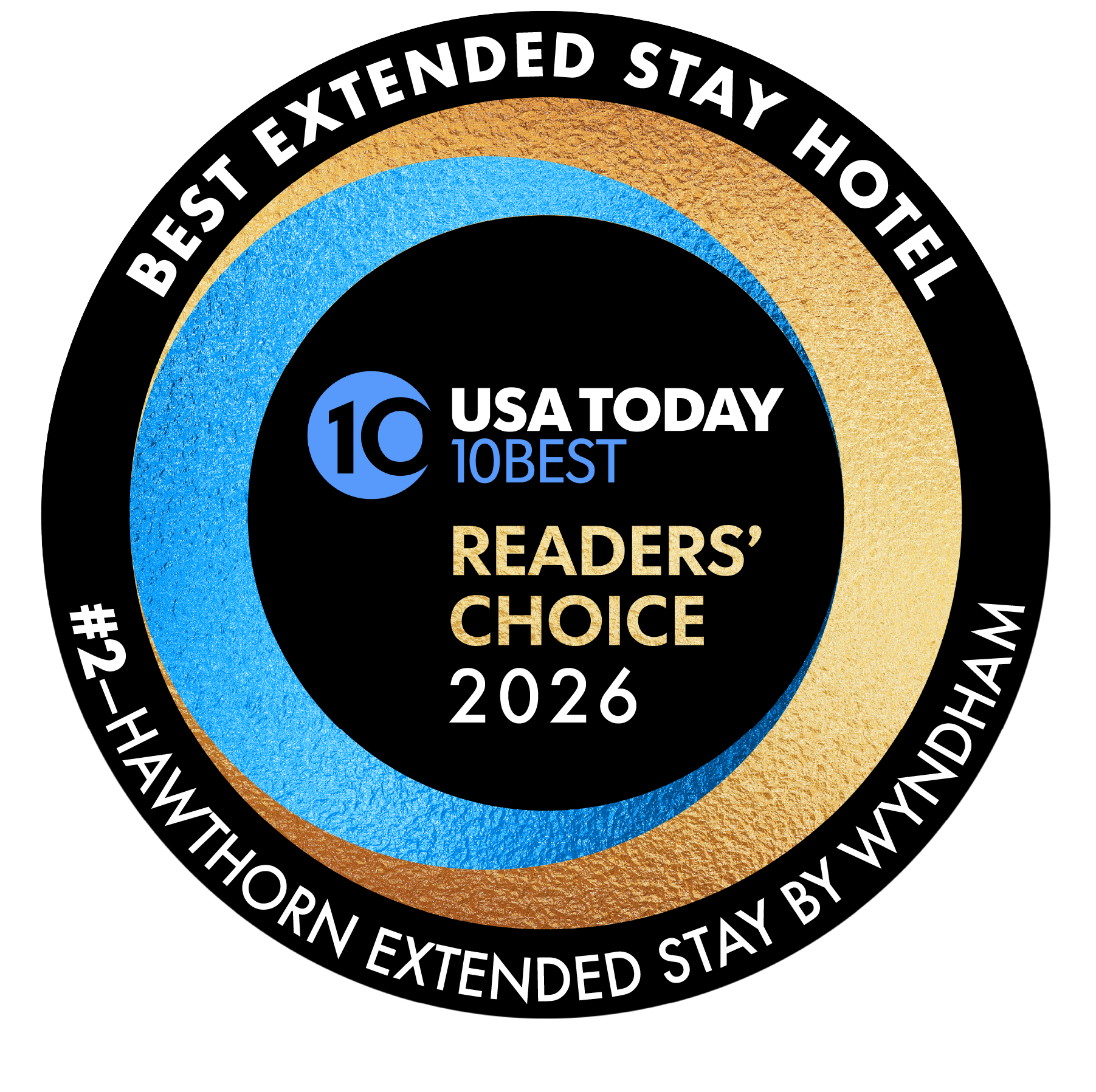
Wyndham holds the top three spots in USA TODAY’s 2026 Readers’ Choice Awards for Best Extended Stay Hotel Brand, ECHO Suites at #1, Hawthorn at #2, WaterWalk at #3, making Wyndham the only major hotel company with top-ranked extended stay brands spanning economy, midscale and upscale. Whether you’re building new, converting an existing hotel, or pairing extended stay with transient demand under one roof, there’s a Wyndham path built for it.
Key Takeaways
- Wyndham swept the top three spots in USA TODAY’s 2026 Readers’ Choice Awards for Best Extended Stay Hotel Brand, the only major hotel company with top-ranked brands across economy, midscale and upscale.
- In owner research, data shows that extended stay is seen as one of the industry’s hottest investment opportunities, with 96% of hotel owners and developers seeing growth potential in the segment1.
- Four development options: ECHO Suites Extended Stay (100% new construction), Hawthorn Extended Stay (new construction or conversion), WaterWalk Extended Stay (new construction or conversion), and a Hawthorn + La Quinta dual-brand concept, available as new construction or conversion.
- Extended stay economics depend on managing length of stay, occupancy and rate together, with fewer room turns and less frequent housekeeping creating opportunities for a leaner operating model.


Which Wyndham extended stay brand is right for your opportunity?
All three of Wyndham’s extended stay brands were ranked in the top three of USA TODAY’s 2026 Readers’ Choice Awards for Best Extended Stay Hotel Brand, ECHO Suites at #1, Hawthorn at #2, WaterWalk at #3, making Wyndham the only major hotel company with top-ranked brands spanning economy, midscale and upscale.
| Wyndham option | Positioning | Development path | Best fit when… |
|---|---|---|---|
| ECHO Suites | Purpose-built extended stay, 7+ nights | 100% new construction | You want an operationally streamlined, ground-up product |
| Hawthorn | Midscale extended stay | New construction, conversion, or dual-brand | You want flexibility across new build, conversion, or a dual-brand pairing |
| WaterWalk | Upscale, Furnished | Unfurnished model | New construction + conversion | The market supports a residential, apartment-style upscale product |
| Hawthorn + La Quinta dual-brand | Upper-midscale transient + midscale extended stay | New construction or conversion | You want to capture both demand types with shared streamlined operations |

ECHO Suites Extended Stay by Wyndham
#1 USA TODAY 2026
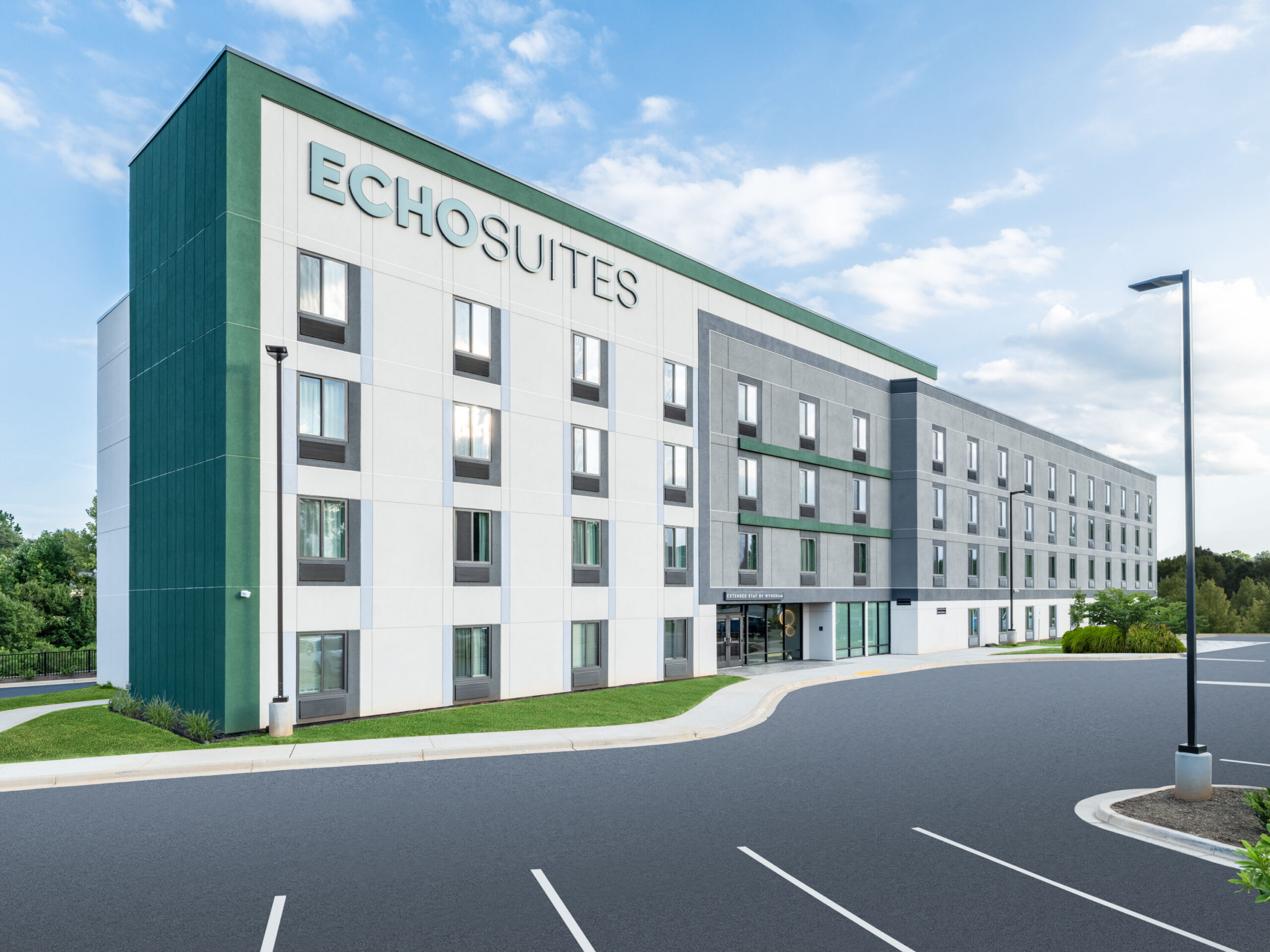
ECHO Suites Extended Stay is a 100% new-construction extended stay brand purpose-built for guests staying seven nights or more, with 79% revenue-generating square footage and a streamlined operating model designed to drive owner ROI. Just two years after opening its first hotel in 2024, the growing ECHO Suites brand has 20 hotels open2, including Savannah, GA, Bozeman, MT, Madison, WI, and Colorado Springs, CO, and more than 300 contracts awarded. It was developed alongside some of the industry’s largest institutional extended stay developers, and Wyndham’s growth strategy is focused on seasoned multi-unit owners and newer operators who want to take advantage of the strong extended stay market.
It is not normal for a new prototype to go from zero to 10+ projects under construction at the same time. With 100% support from Wyndham, we all wanted to move quicker, which we did. I’m happy to report that even though these were initial builds, Wyndham designed a prototype that got it right on the first version.


Hawthorn Extended Stay by Wyndham
#2 USA TODAY 2026
Hawthorn Extended Stay brings a proven extended stay concept to travelers seeking more space and residential-style comforts, with spacious apartment-style accommodations and well-equipped kitchenettes. It’s the most flexible of Wyndham’s extended stay brands, available through new construction, conversion, and dual-brand development. With more than 100 hotels globally3 and a 135% RevPAR Index against its midscale competition4, recent openings include Nashville, TN, Mebane, NC, and Corpus Christi, TX.

WaterWalk Extended Stay by Wyndham
#3 USA TODAY 2026
WaterWalk Extended Stay brings a differentiated approach to upscale extended stay with its Furnished | Unfurnished model: fully furnished units for a traditional extended stay experience, alongside unfurnished units for guests settling in longer-term. The model gives owners the flexibility to adapt the mix of furnished and unfurnished units as market and customer needs change, allowing a single property to serve both traditional extended stay and longer-term residential demand. Across 11 U.S. hotels, including Minneapolis, MN, Phoenix, AZ, and Jacksonville, FL, guests get residential-style comforts like in-unit washers and dryers, modern fitness centers, and pools.

Hawthorn + La Quinta dual-brand
The Hawthorn and La Quinta dual-brand concept combines midscale extended stay with upper-midscale transient demand, available as new construction or conversion, with shared check-in, public areas, back-of-house and amenities designed to create operating efficiencies while serving two guest segments at once. La Quinta by Wyndham was recognized as one of USA TODAY’s Most Trusted Brands for 2026, while Hawthorn ranked #2 in USA TODAY’s 2026 Readers’ Choice Awards for Best Extended Stay Hotel Brand. There are more than 80 dual-brand prototype hotels in the pipeline.5
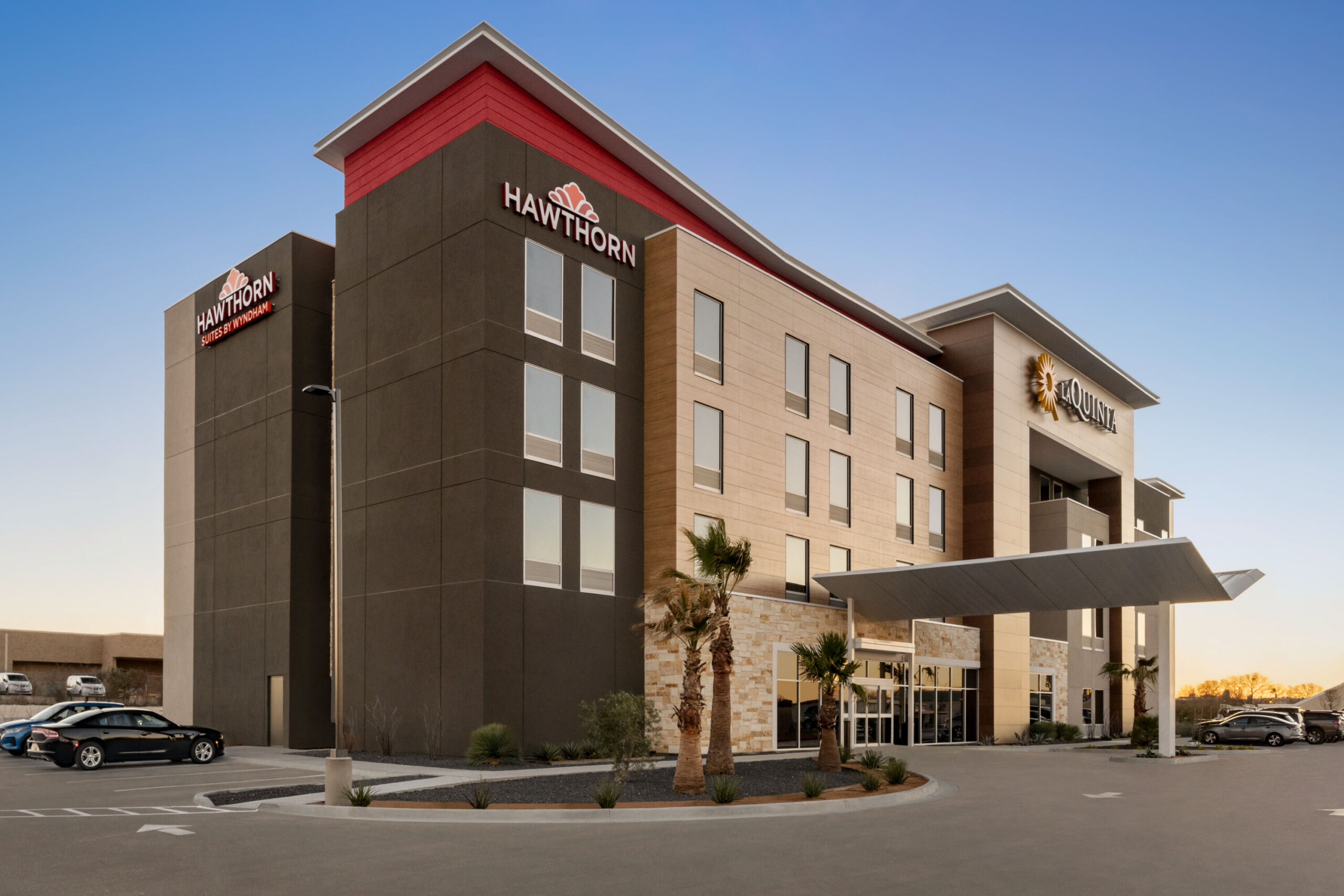
The dual brand has enabled me to efficiently reach two distinct customer segments.
Is extended stay a good investment right now?
Hotel owners and developers remain confident in 2026: 90% are optimistic about the industry this year and 94% over the next five, and 84% call the industry extremely or very resilient.6 Extended stay in particular has popped as one of the industry’s hottest investment opportunities in Wyndham’s owner research.
90% optimistic about the hotel industry in 2026
94% optimistic over the next five years
79% plan to expand their portfolio in the next five years
61% say financing is easier to access than a year ago
37% of hotel owners and developers named extended stay one of the industry’s hottest investment opportunities, with 96% seeing growth potential in the segment overall7
The long-range demand picture backs that up. Global extended stay hotel demand is forecast to reach $190.3 billion by 20358, and Wyndham’s own analysis identified infrastructure-related travel, tied to federal infrastructure legislation, as an approximately $3 billion opportunity for hotel owners and developers over the period of legislation spend.
Are hotel owners choosing new construction or conversion for 2026?
It’s close to an even split. Of hotel owners and developers planning to add to their portfolio in 2026, 52% find new construction more appealing and 48% favor converting or revitalizing an existing hotel6, which is exactly why Wyndham built more than one path into the segment.
How does the extended stay business model work?
Extended stay hotels earn room revenue like any hotel, but longer stays change how rooms are priced, serviced and sold. Longer stays can also mean fewer room turns and less frequent housekeeping, which can create a leaner operating model than traditional transient lodging. Owners typically follow a disciplined operating model balancing length of stay, occupancy and rate together rather than maximizing any one metric on its own, and that balance can be what separates a well-run extended stay property from a struggling one.
The metrics that matter
- LOS — Length of stay
- ESOCC — Extended stay occupancy
- OCC — Overall occupancy
- ADR — Average daily rate
- RevPAR — Revenue per available room
- GOP — Gross operating profit
Why can extended stay hotels operate with less labor than traditional hotels?
Longer guest stays mean fewer checkouts, fewer room resets, and less frequent housekeeping, which lowers labor costs when a property is designed and staffed for it. A traditional hotel might run 20 or more full-time employees; a purpose-built extended stay property like ECHO Suites Extended Stay is designed to operate with roughly 6 to 8.
Why do length of stay and rate need to be managed together?
In extended stay, rate and length of stay work together: pushing rates too high can shorten stays and disrupt occupancy stability, while pricing too low can attract the wrong demand mix. ECHO Suites Extended Stay is specifically designed around a price point that supports this balance. Its target guest prioritizes location, price and safety over costly traditional hotel amenities, helping owners maintain competitive rates while focusing on the longer-term demand the brand was designed to serve.
How does extended stay compare to other real estate investments?
Extended stay hotels share some characteristics with multifamily residential: longer occupancies, more predictable revenue, lower turnover. But they’re still an operating business, not a passive real estate hold. The more useful comparison isn’t asset class vs. asset class, it’s how demand durability, staffing requirements and brand support stack up against the alternative you’re considering.
Owners weighing extended stay against self-storage or multifamily development are usually really asking about durability of income and operating complexity. Extended stay hotels can offer more predictable, recurring revenue than a traditional transient hotel because fewer room turns and longer average stays smooth out the swings that come with nightly demand. At the same time, extended stay remains an operating business with staffing and guest-service requirements, making it more operationally intensive than multifamily or self-storage. For owners already comfortable running an operating business, or willing to bring on a management company, that trade-off is usually a net positive: a leaner staffing model than a traditional hotel, combined with revenue behavior that’s steadier than typical transient lodging.
The most useful comparison is side by side using the economics of the specific opportunity. Compare the extended stay project’s staffing costs, occupancy and rate assumptions, development costs and expected returns with what a self-storage or multifamily project could generate on the same site and capital. A third-party feasibility consultant can help assess the hotel opportunity, while Wyndham’s development team can provide a complimentary market analysis for your specific market.
What drives demand for extended stay hotels?
Extended stay demand is tied to situations where people need to stay in a market longer than a typical trip: infrastructure and construction projects, manufacturing and distribution activity, hospitals and healthcare systems, corporate campuses, military activity, and relocation or temporary housing needs.
- Infrastructure & construction — Multi-year projects, dozens of contractors on site
- Manufacturing & logistics — Plant builds, distribution center activity
- Healthcare — Traveling staff, extended patient family stays
- Corporate & training — Onboarding cohorts, project teams
- Military — Basic training, deployment-adjacent housing
- Relocation & insurance — Moves, displacement, temporary housing
Infrastructure-related travel alone represents an estimated $3.3 billion opportunity for Wyndham hotel owners and developers. A Hawthorn Extended Stay by Wyndham that opened in Texas was contacted almost immediately by the U.S. military, which booked the entire hotel for a year to house personnel in basic training. Read more in our whitepaper, Extended-Stay Hotel Ownership: Expert Insights & Strategies.
How do you evaluate a new construction extended stay opportunity?
Start with demand, not the prototype. Good site selection starts with durable local demand generators, then considers whether the site works operationally and financially, the competitive set, and a development plan that can meet long-stay guest needs at a sustainable investment.
- Demand generators identified
- Competitive set mapped
- Future supply assessed
- Access & visibility confirmed
- Zoning & entitlements checked
- Land basis reviewed
- Prototype fit verified
- Parking & barriers to entry
Should you build new or convert an existing hotel?
New construction gives you full control over layout, kitchenettes and back-of-house space from day one. Conversion can be a faster path to open when the existing building, local market and acquisition economics line up. But a lower acquisition price doesn’t automatically mean a cheaper or faster project. The scope of the property improvement plan (PIP), particularly when converting a traditional transient hotel to extended stay with in-room kitchenettes, can significantly affect the cost and timeline.
| New construction | Conversion |
|---|---|
| Full control over layout & kitchenettes | Can be a faster path to open |
| Built for extended stay from day one | Depends on plumbing, electrical, code fit |
| Predictable construction economics | Property condition and related PIP scope drives real cost |
What does it cost to develop a new construction extended stay hotel?
There’s no single number. Total investment depends on land, site work, market, construction type, room count, prototype, furnishings, labor and material costs, financing, local approvals, and whether the project is new construction or a conversion. A developer’s investment typically includes:
- Land
- Site work
- Hard construction or conversion scope
- FF&E & kitchenettes
- Soft costs & approvals
- Franchise & pre-opening fees
- Financing costs
Construction costs remain a concern for hotel owners and developers in 2026: 67% consider them high right now, though only 26% believe that will translate into fewer new hotels this year6. For estimated initial investment ranges and fees for a specific Wyndham extended stay brand, Wyndham’s development team can walk you through Item 7 of the current Franchise Disclosure Document (FDD) for the brand you’re evaluating.
What does a property improvement plan (PIP) include for an extended stay conversion?
Property Improvement Plan (PIP)
A property improvement plan (PIP) outlines the improvements required to bring an existing hotel into compliance with a brand’s standards as part of a conversion, which can include guest room finishes, kitchenettes, life-safety systems, and public spaces.
Wyndham’s approach to PIPs focuses on improvements that impact the guest experience, which can ultimately help drive rate and returns for owners. For an extended stay conversion, that can include adding or upgrading in-room kitchenettes, addressing the plumbing and electrical work needed to support them, and bringing common areas in line with brand standards. Hawthorn Extended Stay by Wyndham and WaterWalk Extended Stay by Wyndham are both built to accommodate conversions, and Wyndham’s development team scopes the PIP with the specific building and market in mind rather than applying a one-size-fits-all checklist.
Why choose Wyndham for an extended stay hotel franchise?
For hotel owners, the value of a franchise is More than a name® on your hotel. A consistent brand and operating model, guest preference, demand generation and distribution, technology, development expertise and ongoing owner support can all influence the value a brand brings to an opportunity.
That support connects at every stage, from filling rooms to providing support and resources that help owners operate more efficiently:
1. Brand strength & guest preference
A strong hotel brand can influence which hotel a guest chooses. Wyndham invests in building awareness and preference for its brands, and its three extended stay brands hold the top three spots in USA TODAY’s 2026 Readers’ Choice Awards for Best Extended Stay Hotel Brand: ECHO Suites at #1, Hawthorn at #2 and WaterWalk at #3—giving developers recognized options across economy, midscale and upscale.
2. Sales, distribution & loyalty
Wyndham helps owners reach and capture demand through its Wyndham Business team, broad distribution capabilities and, for participating brands, Wyndham Rewards. Wyndham Business connects hotels with small and mid-sized companies as well as Fortune 500 businesses, helping owners tap into business travelers with longer-term stay needs. Wyndham Rewards extends that reach to a loyalty ecosystem with more than 126 million enrolled members.9
3. Technology
Wyndham has invested more than $425 million in technology over the past eight years10 to help owners streamline operations and enhance the guest experience. Tools like Wyndham AI Concierge can address guest needs in real time, create opportunities for upsell and help hotel teams operate more efficiently.
4. Development expertise
Wyndham’s project and architectural teams help owners navigate site, design and development decisions from the start, with dedicated extended stay expertise supporting the project through development and opening.
5. Ongoing owner support
Support doesn’t stop when the hotel opens. Wyndham owners have access to dedicated extended stay expertise to help navigate the distinct operational needs of the segment and help owners meet their business goals.
Frequently asked questions
An extended stay hotel is designed for guests who need accommodations for a week or longer. Compared with a traditional transient hotel, the model puts more emphasis on length of stay, in-room functionality like kitchenettes and storage, amenities such as onsite laundry, lower room turnover, and an operating approach built around long-stay guests rather than nightly check-ins.
| Consideration | Traditional / transient hotel | Extended stay hotel |
|---|---|---|
| Guest stay pattern | Often a few nights | Often a week or longer |
| In-room needs | Built around short stays | Kitchenettes, storage, day-to-day living, dog friendly |
| Room turnover | Frequent checkouts and resets | Fewer turns as guests stay longer |
| Staffing model | Can be as high as 20+ full-time employees | Potentially only 6–8 full-time employees with a brand like ECHO Suites |
| Demand mix | Leisure and short business trips | Projects, relocation, workforce, healthcare, military |
Hotel owners and developers remain confident in 2026, with 90% optimistic about the industry this year and 79% planning to expand their portfolios over the next five years. In Wyndham’s 2025 owner research, 37% named extended stay one of the industry’s hottest investment opportunities and 96% saw growth potential in the segment, though performance still depends on local demand, site economics and execution.
Like any hotel investment, extended stay performance depends on the specific market and opportunity. Developers should evaluate the depth and durability of local demand, existing and planned supply, site economics, development or conversion costs, financing and brand fit. Extended stay also depends on maintaining the right balance of rate, occupancy and length of stay. Working with a third-party feasibility consultant can help developers assess local demand, competitive supply and whether the opportunity supports the proposed hotel.
ECHO Suites Extended Stay is a 100% new-construction brand designed for guests staying 7+ nights, built for operational efficiency. Hawthorn Extended Stay is a midscale brand available through new construction, conversion, or dual-brand development. WaterWalk Extended Stay is Wyndham’s upscale option, built around its Furnished | Unfurnished model. All three were ranked in the top three extended stay brands by USA TODAY readers in 2026.
Look for a brand that fits the market, site, target guest and development strategy, whether you’re building new or converting an existing hotel. Consider the brand’s positioning and guest preference, as well what the franchisor provides through sales and distribution, loyalty, technology, development expertise, and ongoing owner support. The right fit should align the brand’s positioning and operating model with the demand and economics of the specific opportunity.
Yes. Hawthorn Extended Stay, WaterWalk Extended Stay, and the Hawthorn + La Quinta dual-brand concept all offer conversion opportunities. Feasibility depends on the existing room layout, plumbing and kitchen requirements, and the scope of the property improvement plan, which Wyndham’s development team scopes to the specific building and market.
PIP scope is evaluated property by property rather than through a one-size-fits-all checklist. Wyndham focuses on improvements that impact the guest experience and can ultimately help drive rate and returns for owners. For an extended stay conversion, that can include in-room kitchenettes and the plumbing or electrical work needed to support them, along with bringing common areas up to brand standards. Connect with the Wyndham’s development team about what your specific hotel would require.
Extended stay hotels share some characteristics with multifamily and self-storage, including longer-term occupancy, lower turnover and recurring revenue. Unlike those asset classes, however, an extended stay hotel remains an active operating business with staffing and guest-service needs. For investors comfortable with that trade-off, extended stay can combine a leaner staffing model than a traditional hotel with revenue behavior that’s steadier than typical transient lodging. The right comparison ultimately depends on the specific market, site, capital and underwriting assumptions.
For investors considering hotels as a way to diversify their portfolios, Wyndham’s development team regularly works with owners coming from other real estate asset classes to help them understand the hotel business and evaluate whether hotel ownership is a fit for their investment strategy.
There’s no universal number. Costs vary by market, brand, room count, site conditions and whether the project is new construction or a conversion. For estimated initial investment ranges and fees for a specific Wyndham extended stay brand, Wyndham’s development team can walk you through Item 7 of the current Franchise Disclosure Document (FDD) for the brand you’re evaluating.
Development timelines vary based on the project, market, site, brand and whether you’re building new or converting an existing hotel. Entitlements, permitting, financing, design, construction or renovation and other project-specific requirements can all affect the path to opening. Wyndham’s development team can help owners understand the development process and requirements for the brand and opportunity they’re evaluating.
For ECHO Suites Extended Stay as an example, we’ve seen projects as short as 7 months from slab pour to opening, with typical projects taking around 12 months.
Contact Wyndham’s development team about the brand you’re interested in. They can walk you through the current Franchise Disclosure Document (FDD) as part of the franchise evaluation process.
Wyndham supports extended stay owners across development and operations, with project and architectural expertise, dedicated extended stay support, sales and distribution capabilities, and technology designed to help streamline operations and enhance the guest experience. Wyndham has invested more than $450 million in technology over the past eight years, including tools like Wyndham AI Concierge, which can help address guest needs in real time, create upsell opportunities and help hotel teams operate more efficiently.