
Extended stay hotel models are attracting owner attention. According to the Wyndham Hotels & Resorts 2025 Hotel Owner Trends Report, 96% of developers see an opportunity in extended-stay, thanks to both high demand and solid ROI.1
This stems in part from the rise of multi-year infrastructure projects that necessitate corporate agreements for long-term employee stays — 100% of owners in both extended and short-term-stay markets said they anticipate an increase in new business over the next five years.2 With opportunity, however, comes the need for adjustment. The report found that 59% of owners recognize that extended-stay hotels come with different operating models, which can include less frequent housekeeping and reduced front desk hours. Additionally, amenities such as pools and included breakfasts are less important to extended-stay guests than in-room cooking facilities and reliable Internet connections.3
For many owners, this raises a question: When is the right time to take on an extended-stay build? We caught up with Keith Harris, VP, Architecture, Design, and Construction, and Ken Lakra, Senior VP, Head of Global Corporate & Strategic Development at Wyndham Hotels and Resorts, to explore the strategic opportunities offered by ECHO Suites Extended Stay by Wyndham properties.
Exploring the ECHO Suites Extended Stay Advantage
ECHO Suites Extended Stay by Wyndham is the fastest-growing extended-stay brand, with approximately 275 hotels in its pipeline across the United States. For developers, ECHO Suites offers multiple advantages, including:
Streamlined Operations and High Profitability
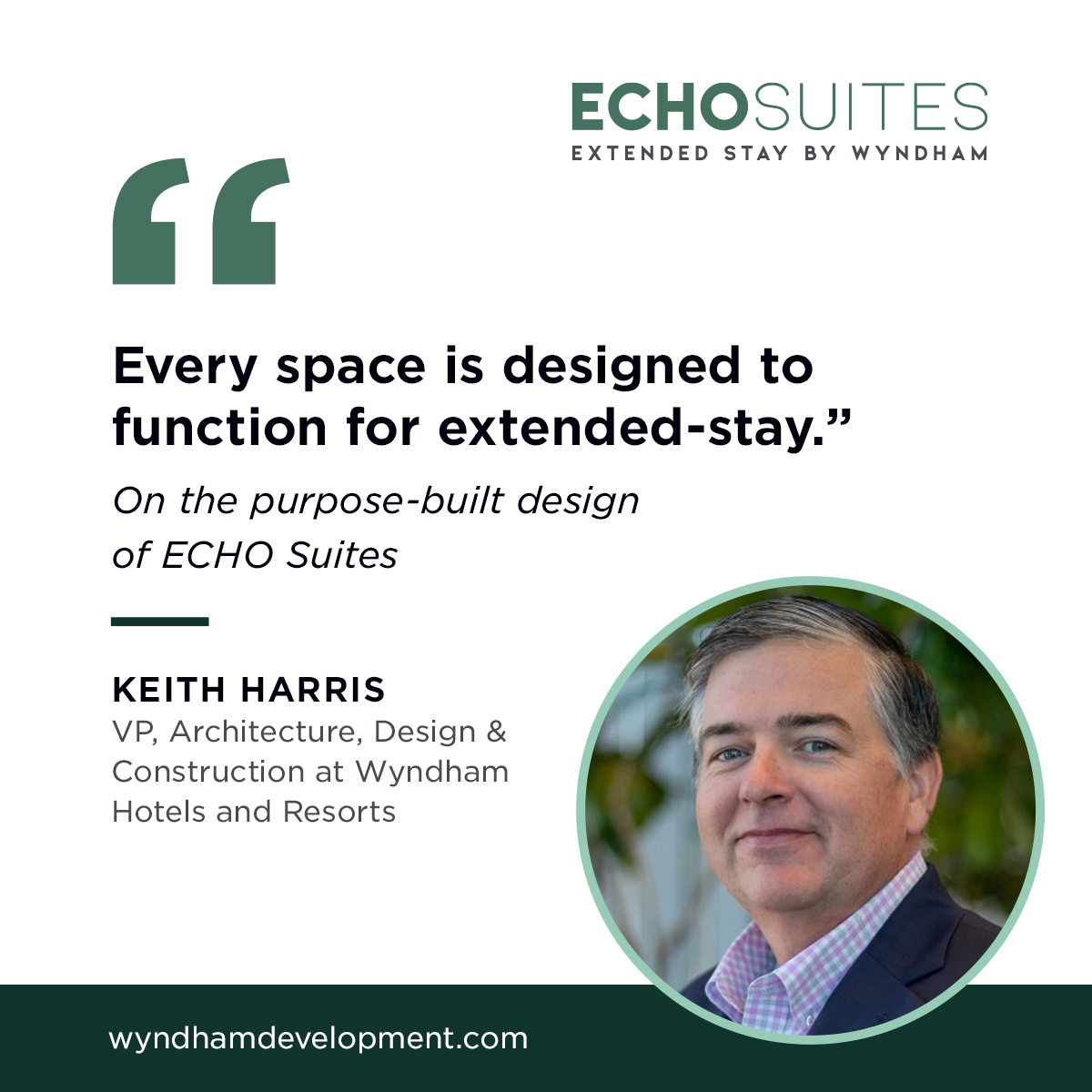
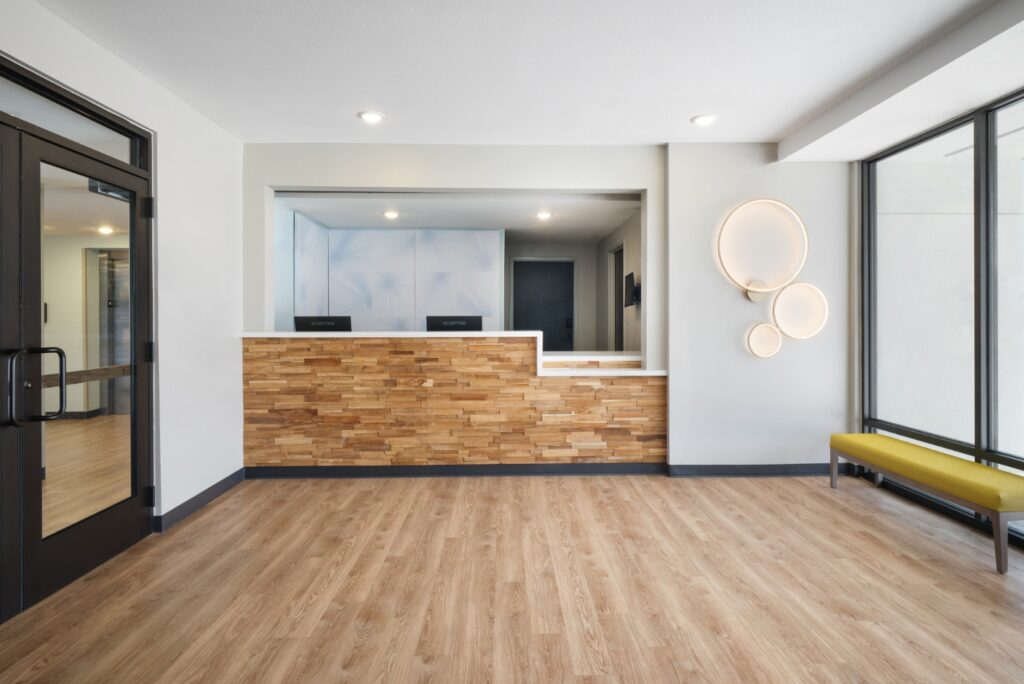
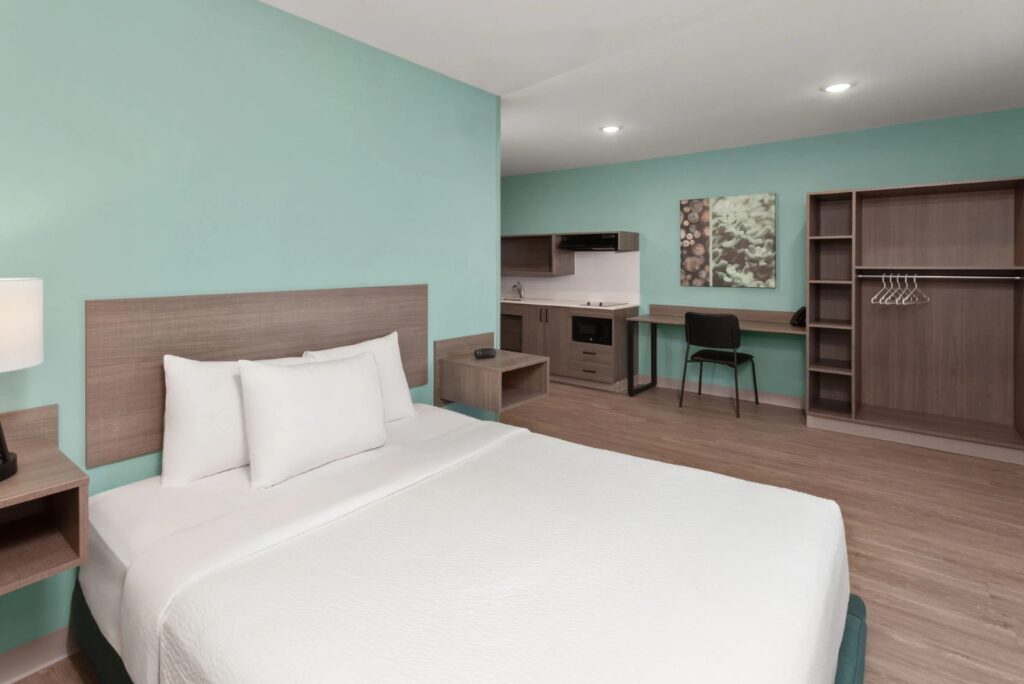
ECHO Suites properties are purpose-built for long-term stays. “Every space is designed to function for extended-stay,” says Harris. All ECHO Suites are 100% new construction. They feature fitness centers, laundry facilities, and vending stations, and are designed to maximize rentable area. The ECHO Suites prototype offers 79% of their square footage as revenue-generating space.
Robust Support and Global Reach
Support is the core of Wyndham’s business model, notes Harris. “There are a lot of support systems in place from the brand to help owners successfully navigate the development process, but that brand support does not end once the hotel opens. There are also a host of operational tools and resources available to both owners and management companies.”
Lakra, meanwhile, makes Wyndham’s position crystal clear: “Owners’ success is our success.” This mentality informs everything the company does, from offering comprehensive revenue and property-level support to creating robust training programs like Wyndham University to providing an end-to-end technology solution with Wyndham Connect.

Preparing for Future Demand
Extended-stay demand is expected to increase as infrastructure projects get underway and guests embrace “bleisure” travel — stays that combine business and leisure. According to the Boston Consulting Group, the growth of bleisure travel spending represents a $15 trillion opportunity for the hotel market.4
As a result, preparing for future demand means considering current conditions and determining the best path forward. Harris suggests that prospective developers ask themselves two key questions.
1) What are my costs of entry and long-term goals?
What does it cost to develop, open, and run an extended-stay hotel? The initial entry point for an ECHO Suites is $13-15 million, but this can vary slightly due to local land costs, labor, permitting, etc.5 (Refer to the Franchise Disclosure Document for more details on construction costs.) Nonetheless, it is a much easier proposition than a speculative build hotel.
How long do you plan to hold the hotel? “Different developers also have different horizons,” says Harris. “Some are looking to buy and sell. Others are looking to keep their properties for 10 or 20 years.” Both approaches are viable, but it’s worth considering which one aligns best with your current needs and future plans.
2) What’s my opportunity cost?
While building an extended stay hotel comes with a sizeable capital cost, Harris notes this isn’t the only cost worth considering. “For example, what is the opportunity cost of not moving forward? This should be a large factor in the decision.”
Seizing the Moment: The Case for Building Now
Now, or later? This is the question for developers: Does it make sense to dive in and spend the money on a new build right now, or wait until market conditions shift?
According to Harris, “This is a really attractive time to build.” Lakra agrees. “Now is a good time. You can develop in two years and get back out there.” In practice, three factors have combined to create a favorable building environment: Falling construction costs, changing loan landscapes, and ongoing market cycles. Here’s a look at each in more detail.
Falling Construction Costs
“Over a multi-year comparison, we have seen hard construction costs decline around 5% based on actual awarded bids for projects that were built or under construction,” says Harris. “This begs the question: Why? A lot is based on overall macroeconomic conditions. For example, many commercial real estate development projects have paused, and residential starts are slow, freeing up capacity for the specialty trades that are critical for new hotel construction.”
During these times, developers who move forward with projects are able to take advantage of this inflection. As cycles change, contractors, subcontractors, and material suppliers regain pricing power lost during slower cycles.
Harris points to positive momentum with materials like lumber, which remain cost-effective after a significant spike five years ago.
Changing Loan Landscapes
Loan landscapes are also changing.
“When it comes to financing markets, people no longer expect a return to zero percent interest rate financing and have reset expectations,” says Lakra. “For example, 10-year treasuries — which most lending is based on — now hover around 4%.” The Federal Reserve, meanwhile, may continue to cut the federal funds rate. This typically influences the overall interest rate curve and often results in lower financing rates.
“Construction financing remains challenging,” says Harris, “but there are viable options in the market for new construction extended-stay projects. ”It’s worth taking a shorter-term view of construction financing, especially when it comes to interest rates,” says Harris. “The challenge in today’s environment is to get the project constructed and open. Once the hotel is operational, the number of lenders and types of financing available increase significantly to align with long-term investment goals.”
Ongoing Market Cycles
Markets are naturally cyclical. As interest rates rise, labor and material costs fall. These conditions often prompt more development efforts, which in turn lead to falling rates and increasing construction costs.
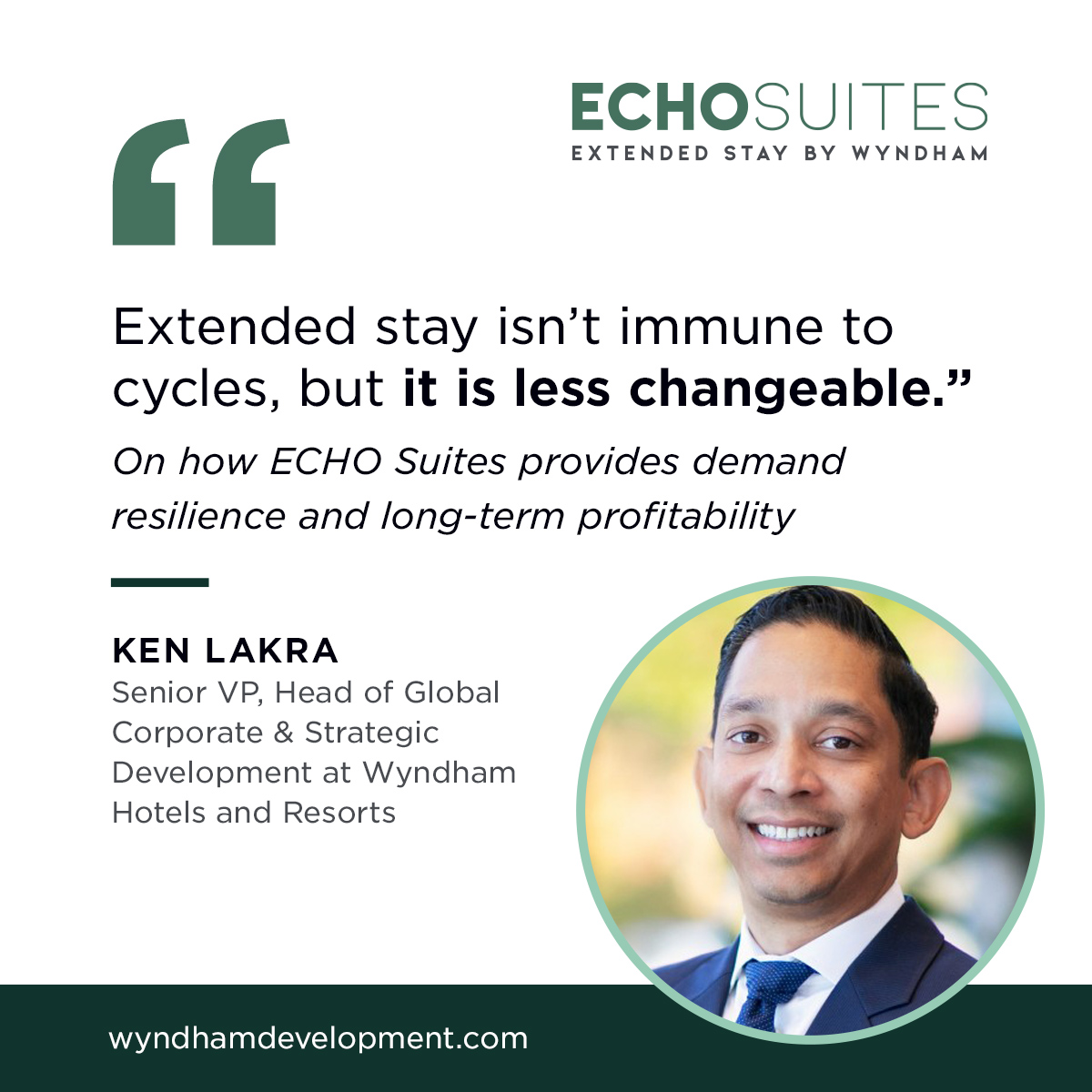
“We feel that we’re beyond the peak interest rates,” says Lakra. “Economists see rates coming down, and things are looking more favorable and predictable.” He also notes that the nature of extended stay makes it less susceptible to market conditions. “A lot of our demand generators are things that aren’t really affected by the economy that much. Extended stay isn’t immune to cycles, but it is less changeable.”
While there is no “perfect” time to build — markets change unpredictably, and financial conditions evolve in response to geopolitical factors — it’s fair to say that the current environment supports developers and owners who take the plunge.
For Lakra, it’s all about identifying your decision point. “It’s important that you do all the prep now to be prepared. Budget your costs, scope out sites, identify your expected capital structure, and model out your expected cash flows. You can then work with lenders to see what financing rates and capital structures are available to you. If the returns work, now is the time to take advantage but otherwise, you are ready to go when financing becomes attractive. If you wait until financing rates have come down further and not complete any of the prep work upfront, you will be behind and potentially building in less profitable locations.”
There’s No Time Like the Present
While there’s no “perfect” time to take the plunge and build a hotel, current conditions, coupled with strong market performance, make an ECHO Suites Extended Stay by Wyndham a solid investment for owners. Harris puts it simply: “There’s never a Goldilocks moment for when to pull the trigger. As the saying goes, the best time to plant a tree was 20 years ago. The next best is today.”
1https://corporate.wyndhamhotels.com/news-releases/wyndhams-first-annual-owner-trends-report-highlights-positive-long-term-outlook-vital-role-of-brands/
2https://corporate.wyndhamhotels.com/news-releases/wyndhams-first-annual-owner-trends-report-highlights-positive-long-term-outlook-vital-role-of-brands/
3https://corporate.wyndhamhotels.com/news-releases/wyndhams-first-annual-owner-trends-report-highlights-positive-long-term-outlook-vital-role-of-brands/
4https://www.bcg.com/publications/2025/the-15-trillion-opportunity-in-leisure-travel